¿Por qué los indicadores biológicos de óxido de etileno utilizan Bacillus atrophaeus y qué deben verificar los compradores?
Release time: 2026-11-12
Tabla de contenido
Ethylene oxide (EO) sterilization is widely used for medical devices and healthcare products that cannot withstand high temperatures or moisture. Because EO sterilization involves specific gas concentration, temperature, humidity, and exposure time requirements, verifying sterilization effectiveness is essential for maintaining product safety and quality.
Biological indicators (BIs) provide a direct method for evaluating the effectiveness of sterilization processes by using highly resistant microorganisms to challenge the sterilization cycle. For ethylene oxide sterilization, Bacillus atrophaeus is the commonly specified test microorganism.
However, selecting an appropriate ethylene oxide biological indicator involves more than confirming the bacterial species. Buyers also need to evaluate spore population, resistance characteristics, carrier materials, packaging compatibility, incubation conditions, and test documentation.
Understanding these factors helps medical device manufacturers, sterilization service providers, and healthcare packaging buyers select biological indicators that meet their process verification requirements.
1. ¿Por qué se utiliza Bacillus atrophaeus en la esterilización con óxido de etileno?
Bacillus atrophaeus is a bacterial species commonly used in biological indicators for ethylene oxide sterilization because of its relatively high resistance to EO under specified test conditions.
Biological indicators contain bacterial spores that are more resistant to sterilization than ordinary vegetative microorganisms. Their resistance makes them suitable for challenging sterilization processes and evaluating whether the required microbial inactivation has been achieved.
Several characteristics make Bacillus atrophaeus suitable for EO sterilization monitoring:
High resistance to ethylene oxide
Bacterial spores have protective structures and physiological characteristics that make them more resistant to environmental stress than vegetative bacterial cells. Bacillus atrophaeus spores provide a standardized biological challenge for evaluating EO sterilization effectiveness.
Established use in sterilization validation
Bacillus atrophaeus is widely recognized in EO sterilization standards and biological indicator applications. Its established use supports standardized testing and comparison of sterilization performance.
Measurable biological response
After exposure to a sterilization cycle, the biological indicator can be incubated under specified conditions to determine whether viable spores remain. The resulting growth or no-growth response provides evidence about the effectiveness of the sterilization process.
It is important to note that biological indicators do not replace physical and chemical monitoring. They provide complementary evidence within a broader sterilization validation and routine monitoring program.
2. ¿Cómo funciona un indicador biológico de óxido de etileno?
An ethylene oxide biological indicator typically contains a defined population of Bacillus atrophaeus spores on a suitable carrier or within a designated biological indicator system.
During sterilization, the indicator is exposed to the same EO process conditions used for the products being evaluated.
The general testing procedure involves several stages.
Step 1: Indicator preparation
The biological indicator is prepared according to the manufacturer’s instructions. Buyers and users should verify the spore population, carrier specifications, product identification, and expiration date before use.
Step 2: Exposure to EO sterilization
The indicator is placed at an appropriate location within the sterilization load or process challenge device. Its position should represent a relevant or challenging location for EO penetration.
Step 3: Incubation
After sterilization, the biological indicator is transferred to the appropriate recovery or culture system and incubated under the specified conditions.
Step 4: Result interpretation
The test result is evaluated according to the manufacturer’s instructions and applicable standards.
- A positive growth result indicates that viable microorganisms remain.
- A negative growth result indicates that no growth was detected under the specified test conditions.
Appropriate positive controls are important for confirming that the biological indicator and incubation procedure can produce the expected growth response.
The interpretation should also consider the complete test protocol, including incubation conditions, control results, and any required confirmation procedures.
3. ¿Qué deben verificar los compradores al seleccionar un indicador biológico de óxido de etileno?
Not all biological indicators have identical specifications. Even when two products use Bacillus atrophaeus, their performance characteristics, packaging configurations, and intended applications may differ.
Before purchasing an ethylene oxide biological indicator, buyers should evaluate the following factors.
Población de esporas y recuento de células viables
The spore population determines the initial microbial challenge presented by the biological indicator.
Buyers should check:
- The stated population of viable spores per indicator.
- Whether the population is supported by a certificate of analysis.
- The consistency of spore loading between production batches.
- Whether the population is suitable for the intended validation or routine monitoring application.
A higher spore population does not automatically mean a biological indicator is better. The selected population should meet the applicable standard and the requirements of the sterilization validation protocol.
Valor D y características de resistencia
The D-value is an important performance parameter for biological indicators. It represents the time required under specified sterilization conditions to achieve a 90% reduction in the viable microorganism population.
For EO biological indicators, resistance characteristics should be evaluated under the relevant test conditions.
Buyers should verify:
- The reported D-value and its test conditions.
- Whether resistance data are supported by appropriate testing.
- The consistency of resistance characteristics between batches.
- Whether the indicator is suitable for the intended EO sterilization cycle.
D-values should not be compared without considering the test conditions, since EO concentration, temperature, and humidity can influence measured resistance.
Diseño de materiales portadores y embalajes
The carrier provides a surface for the bacterial spores and influences how the indicator is handled and exposed during sterilization.
Depending on the product design, biological indicators may use paper carriers or other suitable materials.
Buyers should consider whether the carrier:
- Maintains spore stability during storage.
- Is compatible with the intended EO sterilization conditions.
- Allows appropriate recovery of surviving microorganisms.
- Can be handled without contamination or damage.
Packaging design also matters. The biological indicator must remain protected before use while allowing the intended sterilization process and subsequent testing procedures to be performed correctly.
Tiempo de incubación y disponibilidad de resultados
The time required to obtain a biological indicator result can affect production schedules and sterilization release procedures.
Traditional culture-based biological indicators may require a relatively long incubation period, depending on the product specifications and applicable test method.
Some rapid-readout systems are designed to provide results within shorter periods. Buyers should distinguish between the manufacturer’s claimed detection time and the complete time required for an approved result under the relevant testing procedure.
For example, a 24-hour EO biological indicator may be suitable for applications where a shorter result turnaround is required, provided its performance has been validated for the intended use.
Documentación y trazabilidad
Reliable documentation is essential for medical device manufacturers and sterilization service providers.
Before ordering, buyers should request relevant technical information, including:
- Product specifications and instructions for use.
- Microorganism identification.
- Spore population and resistance data.
- Certificate of analysis.
- Storage conditions and shelf life.
- Incubation requirements and result interpretation instructions.
- Relevant compliance and validation documentation.
These records support supplier qualification, incoming quality control, sterilization validation, and ongoing process monitoring.
4. Indicadores biológicos EO frente a indicadores biológicos Steam: ¿Cuál es la diferencia?
EO and steam sterilization use different mechanisms, operating conditions, and biological indicator requirements. Therefore, the biological indicators used for these processes are not interchangeable.
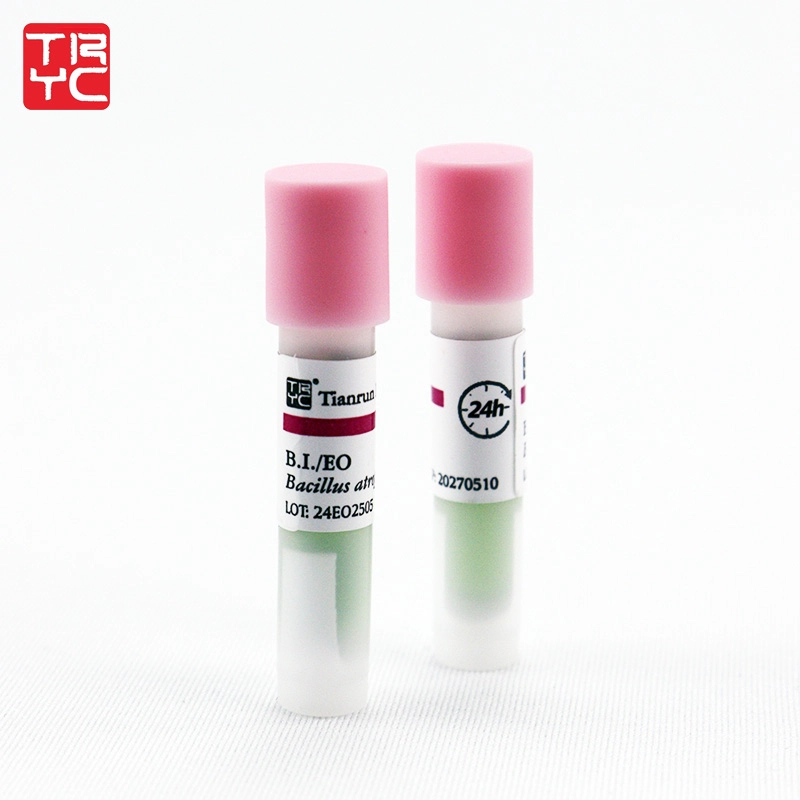
Ethylene oxide biological indicators
EO biological indicators commonly use Bacillus atrophaeus spores. They are designed to evaluate sterilization processes involving EO gas and the associated temperature, humidity, gas concentration, and exposure time conditions.
Indicadores biológicos de vapor
Steam biological indicator products typically use Geobacillus stearothermophilus spores because of their high resistance to moist heat.

These indicators are used to evaluate steam sterilization processes, including autoclave cycles, where saturated steam and temperature are the primary sterilizing factors.
The key differences include:
- Test microorganism: Bacillus atrophaeus for EO applications and Geobacillus stearothermophilus for steam applications.
- Sterilization conditions: EO gas exposure versus saturated steam under controlled temperature and pressure.
- Resistance characteristics: Each microorganism is selected and characterized for its suitability under the corresponding sterilization conditions.
- Solicitud: EO biological indicators are used for EO cycle monitoring, while steam biological indicators are intended for moist heat sterilization monitoring.
When purchasing biological indicators for multiple sterilization processes, buyers should confirm the microorganism, product designation, resistance specifications, and intended application rather than selecting products based only on their general biological indicator category.
5. Cómo evaluar a un fabricante de indicadores biológicos para requisitos personalizados
For medical device manufacturers and sterilization service providers, standard biological indicator specifications may not always meet every application requirement.
Some buyers need specific spore populations, carrier configurations, packaging formats, labeling information, or documentation arrangements.
When sourcing custom biological indicators for sterilization, several supplier capabilities deserve attention.
Customization capabilities
Confirm whether the supplier can accommodate different spore populations, carrier materials, product dimensions, packaging configurations, and labeling requirements.
Quality control
Ask how the supplier controls microorganism identification, spore loading, resistance characteristics, product stability, and batch consistency.
Technical support
A qualified supplier should be able to explain the biological indicator’s intended application, incubation procedure, performance specifications, and limitations.
Production consistency
For repeat orders, consistent product specifications and traceable batch documentation are important for maintaining reliable testing procedures.
Regulatory and standards documentation
Depending on the application, buyers should review relevant requirements, including ISO 11138-1 for general requirements for biological indicators and ISO 11138-2 for biological indicators used in ethylene oxide sterilization.
For steam applications, ISO 11138-3 provides the corresponding requirements for biological indicators used in moist heat sterilization.
A supplier’s ability to provide relevant documentation and technical information is an important part of the purchasing decision.
Preguntas frecuentes
1. Why is Bacillus atrophaeus preferred for EO biological indicators?
Bacillus atrophaeus spores have established resistance characteristics under ethylene oxide sterilization conditions. Their use provides a standardized biological challenge for evaluating EO sterilization effectiveness.
2. Can a steam biological indicator be used for EO sterilization?
No. Steam and EO sterilization require different biological indicator microorganisms. Bacillus atrophaeus is commonly used for EO applications, while Geobacillus stearothermophilus is used for steam sterilization.
3. What does a 24-hour EO biological indicator mean?
It generally refers to a biological indicator designed to provide a test result within a specified 24-hour incubation period. Buyers should verify the actual incubation requirements, detection method, and validated performance before selecting the product.
4. What documents should buyers request when purchasing biological indicators?
Commonly requested documents include product specifications, instructions for use, certificates of analysis, spore population data, D-value information, storage requirements, shelf-life information, and relevant compliance documentation.
Selección del indicador biológico adecuado
Choosing an EO biological indicator requires attention to microorganism selection, spore population, resistance characteristics, incubation time, and documentation. Buyers should evaluate these specifications against their sterilization validation protocols rather than relying on product names alone.
Materiales de embalaje médico Anhui Tianrun Co., Ltd. provides biological indicator products for different sterilization applications, including EO and steam sterilization. Buyers can assess the available specifications and customization options according to their process requirements before placing an order.